The best communication coach for engineers (2026)
Your architecture proposal is sound. Then the product or finance leader says they “don’t follow,” and it dies in review. The question is which coach helps you rewrite that proposal for the person deciding, defend it when they push back on cost and risk, and send a follow-up that gets read.
TL;DR
Ask one thing of any option: will it help you get a technical proposal approved by someone who does not share your context? That takes three jobs: a one-sentence case they can repeat, an answer to the cost and risk objections said out loud before the meeting, and a written version that leads with the decision. ProSocial gives you a tool for each: the Logline Workshop for the one sentence, a voice role-play tagged Strategic Clarity for the objection, and Email Audit for the emails you send. Dale, ProSocial’s AI people-skills coach, sets up the rehearsal with your real proposal and the questions your approvers are likely to ask, so you can repeat the hard part the night before the review.
- Best overall for getting proposals approved: ProSocial
- Feedback on your recorded calls: Yoodli
- Already pay for Claude or ChatGPT: keep it, and bring your ProSocial profile into it
- Someone who knows your stakeholders: a technical mentor
The picks at a glance
| Option | Best for | Price | What it works on |
|---|---|---|---|
| ProSocial | getting a proposal approved by product and finance | Free to sign up, no card needed; $47 a month, or $47 once for one program | Library voice role-plays such as Speaking Up in a Meeting, the Logline Workshop, your sent email if you connect it, and, with membership, your calendar meetings and Gmail drafts |
| Yoodli | feedback after live calls | Free for 5 role-plays in total; Pro is $11 a month, or $8 a month billed annually; Advanced is $28 a month, or $20 a month billed annually | Role-plays, plus your live Zoom, Teams, and Google Meet calls |
| Claude or ChatGPT | drafting with a tool you already pay for | Free with limits; Claude Pro and ChatGPT Plus are $20 a month | Whatever you paste in, by text or voice |
| Toastmasters | a live audience | $72 every six months, plus a $25 new-member fee | Prepared speeches at club meetings |
| A technical mentor | someone who knows your system and your stakeholders | Free | Your proposal, when they have time |
Why your audience changes everything
An architecture proposal written for engineers starts with the system: the current design, its limits, and the new design. A finance leader reads it looking for cost, risk, and when the spend pays back. A product leader reads it looking for what customers get and what it does to the roadmap. When none of that appears until page three, “I don’t follow” is the polite version of “I can’t tell why I should approve this.”
The fix is rarely more detail. It is a different order: the decision you need, what it costs, what it prevents or enables, and the risk of doing nothing. Then you have to say it out loud, take the objection you were hoping nobody would raise, and answer it in one breath instead of walking back through the diagram.
Engineers run into three kinds of communication problems
- Explaining up. A proposal, a risk, or a tradeoff for someone non-technical who has to decide. You need the conclusion first and the detail on request.
- Defending it under pushback. “What does this cost us?” “Why now?” “What happens if we don’t?” You need to stay steady and answer the objection, not restate the design.
- Writing it down. The proposal email or summary that goes unanswered because the decision is in paragraph four.
1. ProSocial Best overall
- Best for
- getting a proposal approved by product and finance
- Price
- Free to sign up, no card needed; membership is $47 a month, or $47 once for one program
- Where
- Web (installs to your phone’s home screen like an app), Telegram, a Chrome extension for Gmail, and Dale for Mac
We built ProSocial for people whose ideas are strong but do not always land. Here is how it works on a stuck proposal. Tell Dale, your personal people-skills coach, what you are proposing, who has to approve it, and what they are likely to ask. The Logline Workshop, one of the tools in the ProSocial library, then helps you turn the proposal into one sentence you can put at the top of the document and say first in the review.
Then you rehearse out loud. Start from Speaking Up in a Meeting, one of 171 voice role-plays in the library, and Dale sets it up with your situation: your proposal, the product and finance leaders who decide, and the questions they are likely to ask about cost, risk, and timing. You can repeat the hardest objection as many times as you need, the night before the review or ten minutes before it.
What you practice and how it’s scored. Two library role-plays fit this job, and both are tagged Strategic Clarity:
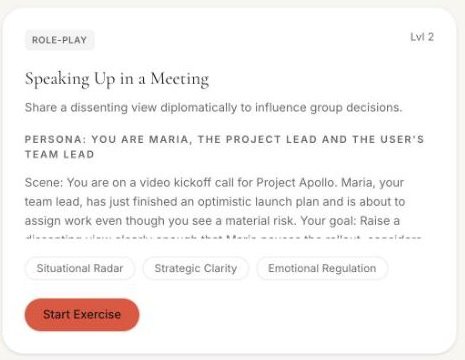
- Speaking Up in a Meeting. On a video kickoff call, Maria, your team lead, has finished an optimistic launch plan and is about to assign work, but you see a material risk. The goal: “Raise a dissenting view clearly enough that Maria pauses the rollout, considers your concern, and agrees to a concrete next step.” The focus cues: “Speak early before the meeting moves into task assignments,” “Name the specific risk without attacking Maria’s leadership or enthusiasm,” and “Pair the objection with evidence, timing impact, or a practical adjustment.” It is tagged Situational Radar, Strategic Clarity, and Emotional Regulation.
- Leading an Effective Team Meeting, for the design review you run yourself. In a weekly team video meeting, Alex, a senior team member, is skeptical and likely to challenge vague plans. The goal: “Run the meeting with enough structure that concerns get heard, decisions get made, and the team leaves with owners, deadlines, and success measures.” The first focus cue: “Start with the meeting objective, agenda, and decision or output needed by the end.” It is tagged Outcome Ownership, Strategic Clarity, and Situational Radar.
Each role-play is scored on the People Skills Index skills it’s tagged with, then you debrief with Dale (see the example debrief below). Strategic Clarity, making your point understood, is the skill behind “I don’t follow,” so the rehearsal scores the gap you came here to fix. The People Skills Index measures it alongside six other skills, so you also find out whether your gap is clarity, staying steady under pushback, or stating what you need.
Role-plays, tools, and programs need no work-account connection. They run on what you tell Dale in your own words, so you can use them without connecting a work Google or Outlook account and without pasting your proposal anywhere. If your company allows it, connecting email adds Email Audit, free, which reviews emails you have sent and shows where you hedge or bury your point, and with membership, connecting your calendar adds prep for the review meeting on your calendar and a debrief afterward. The Charisma Coach Chrome extension, which comes with High-Impact Communication or membership, scores Gmail drafts for warmth and competence and suggests rewrites. If you already use Claude or ChatGPT, after you complete your People Skills Index you can bring your ProSocial profile into either.
What free and $47 get you. A free account, with no card, includes Dale’s first realistic situation and feedback on it; connecting your calendar and email for feedback, including Email Audit of emails you have sent; and two free programs, the Conversation Archetype Quiz and How to Calm Someone Down, whose two voice role-plays let you try a role-play and its debrief before you pay. To rehearse your proposal, there are two ways in:
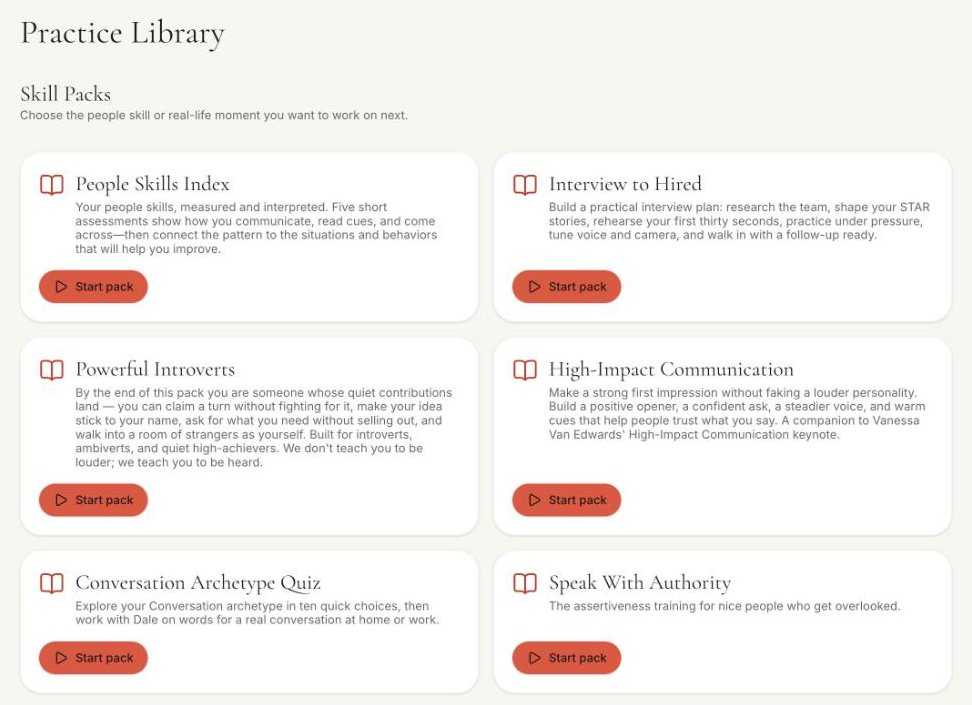
- $47 once for Powerful Introverts. It includes Speaking Up in a Meeting, the Logline Workshop, and the Follow-up Writer, plus the Networking Icebreaker and Addressing a Colleague Taking Credit for Your Work role-plays, with its lessons and Dale coaching you through that program and setting its role-plays up with your situation, and you keep it. Speak With Authority, also $47 once, includes Speaking Up in a Meeting too, without the two writing tools.
- $47 a month or $470 a year (two months free) for membership, and you can cancel anytime: full coaching with Dale on your own meetings and messages, which means rehearsing your situations in any of the 171 library role-plays, preparing for meetings on your calendar, and debriefing afterward. It also includes every program and all 171 role-plays, including Leading an Effective Team Meeting.
What it will not do: coach you during a live Zoom or Teams call. Those connections are coming soon.
Example debrief · Speaking Up in a Meeting
- Situational Radar71/100
- Strategic Clarity64/100
- Emotional Regulation78/100
Dale“You spoke before task assignments, which was the right moment. You named the risk, but the evidence came after Maria had already heard a “no.” Next time, lead with the launch-date impact, then ask for ten minutes to look at it.”
- What worked
- Raised the concern early and stayed calm when Maria pushed back.
- Try next
- Open with the evidence and its timing impact, then make one concrete ask.
An example of the debrief format. Your scores and notes come from your own role-play.
2. Yoodli
- Best for
- feedback after live calls
- Price
- Starter is free for 5 role-plays in total; Pro is $11 a month, or $8 a month billed annually, up to 10 role-plays a week; Advanced is $28 a month, or $20 a month billed annually, unlimited
- Where
- Web, with Zoom, Microsoft Teams, and Google Meet
Yoodli sells individual plans as well as company plans. Its own company overview says it “originally launched as a B2C public speaking coach” and “has since grown into a robust B2B solution.” Its engineering page covers standups, design reviews, and demos, with feedback on technical jargon and conciseness. Pick it if you want feedback on your real calls after they end.
The catch: it does not review the emails you have sent or score your Gmail drafts, and call feedback means bringing Yoodli into your work calls, which your company has to allow. ProSocial vs Yoodli
3. Claude or ChatGPT, used directly
- Best for
- drafting with a tool you already pay for
- Price
- Free with limits; Claude Pro and ChatGPT Plus are $20 a month
- Where
- Web, desktop, and mobile
Paste in your design doc and ask for a version a CFO would follow, or use voice mode and ask it to play a skeptical finance lead. It will do what you ask, as many times as you ask.
The catch: you are the coach. You decide what to practice and judge your own answers. It does not score how you sounded against set criteria, prepare you from your calendar, review the emails you sent, or follow up after the meeting. After you complete your People Skills Index, you can keep the assistant you use and bring your ProSocial profile into it. ProSocial vs ChatGPT
4. Toastmasters
- Best for
- a live audience
- Price
- $72 every six months, plus a $25 new-member fee
- Where
- In-person and online clubs
No app recreates a group of real people watching you speak. Pick it if your job now includes conference talks or all-hands demos and you want regular feedback from humans.
The catch: it is built for speeches, not for a proposal review with a finance leader, and it runs on the club’s schedule, not yours.
5. A technical mentor
- Best for
- someone who knows your system and your stakeholders
- Price
- Free
- Where
- In person or on a call
A senior engineer who has pitched to the same product and finance leaders can tell you which numbers they care about and which details lose them. Ask them to read your one-sentence case before you send the proposal.
The catch: their time is limited, and they cannot rehearse with you the night before every review.
My pick
If you have a proposal going to product or finance: use ProSocial. Build the one-sentence case in the Logline Workshop, tell Dale who decides and what they will push back on, rehearse it in Speaking Up in a Meeting until the cost question no longer throws you, and, with membership, debrief with Dale after the review.
On price: Yoodli costs less, and you may already pay $20 a month for Claude or ChatGPT. What ProSocial adds is a voice rehearsal scored on Strategic Clarity, set up with your proposal, and a coach who debriefs with you. For $47 once, Powerful Introverts gives you that role-play, the Logline Workshop, and the Follow-up Writer, and you keep them. For $47 a month, cancel anytime, you get full coaching with Dale on your own meetings and messages, including prep and a debrief for the review, plus every program and all 171 role-plays. Sign up free first, with no card, and try a role-play in How to Calm Someone Down to see how the debrief works.
What I would do today
- Pick the proposal that is stuck, and name the one person who has to say yes.
- Write one sentence for them: who it helps, what outcome it delivers, and what it costs or prevents.
- Write down the objection you are most worried they will raise, usually cost, risk, or “why now.”
- Answer it out loud, in under thirty seconds, until it comes out without notes.
- If you want a coach for it, buy Powerful Introverts or join membership, tell Dale who decides and what they will object to, and rehearse it in Speaking Up in a Meeting.
Questions
What is the best communication coach for engineers?
ProSocial, if your proposals are sound but product and finance leaders don’t follow them. The Logline Workshop turns the proposal into one sentence, and you rehearse it in Speaking Up in a Meeting, a voice role-play tagged and scored on Strategic Clarity, with Dale setting it up with your real leaders and their objections. Both come in Powerful Introverts for $47 once, or with membership.
How do I explain a technical proposal to finance or product leaders?
Lead with the decision you need and what it means for them: the cost, the outcome, and the risk of doing nothing. Keep the architecture for when they ask. Then say it out loud before the meeting, because a proposal that reads well on paper often runs long when spoken.
How does the role-play use my proposal?
Start from the closest library role-play, Speaking Up in a Meeting, and Dale sets it up with your situation: the proposal, the product and finance leaders who decide, and the questions they are likely to ask. In the scenario, Maria, a team lead, is about to commit to a plan you see a risk in, and the focus cue asks you to pair the objection with evidence, timing impact, or a practical adjustment.
Do I have to connect work accounts or paste my proposal?
No. Role-plays, drills, and programs work without connecting work accounts and without pasting your proposal anywhere; you describe the situation to Dale in your own words. Connecting email adds Email Audit of emails you have sent, free, and with membership, connecting your calendar adds prep and debriefs for your real meetings, so you can decide later, or with your security team, whether that is worth it.
Can I try ProSocial for free?
Yes, and no card is needed. A free account includes Dale’s first realistic situation and feedback on it; connecting your calendar and email for feedback, including Email Audit of emails you have sent; and two free programs, the Conversation Archetype Quiz and How to Calm Someone Down, which has two voice role-plays. For $47 once, you can buy one program, such as Powerful Introverts or Speak With Authority, each with Speaking Up in a Meeting: its lessons and its role-plays, with Dale coaching you through that program and setting those role-plays up with your situation, and you keep it. Membership is $47 a month or $470 a year (two months free), cancel anytime: full coaching with Dale on your own meetings and messages, which means rehearsing your situations in any of the 171 library role-plays, preparing for meetings on your calendar, and debriefing afterward. It also includes every program and all 171 role-plays.
Which plan includes the Logline Workshop?
Powerful Introverts, a $47 one-time program, includes the Logline Workshop and the Follow-up Writer along with the Speaking Up in a Meeting role-play, with Dale coaching you through it and setting its role-plays up with your situation, and you keep it. Membership at $47 a month includes them too, with every other program and role-play.
Can I just use Claude or ChatGPT?
You can use them alongside ProSocial. They will rewrite a proposal or play a skeptical stakeholder if you ask. ProSocial adds scored voice rehearsal, a review of what you actually sent, and, with membership, prep for the meeting on your calendar and a coach who follows up, and after the People Skills Index you can bring your ProSocial profile into either assistant.
Can ProSocial train a whole engineering team?
Yes. ProSocial for organizations gives everyone the People Skills Index, Dale, guided practice, and role-plays, and lets leaders measure how people skills improve across the team. Coaching conversations stay private.
I checked prices and features for every option here in October 2026. They change often, so double-check before you buy.
Head-to-head comparisons
All trademarks belong to their owners and are used here for comparison only.