The best app to practice difficult conversations at work (2026)
You have been putting off a conversation with a peer, your manager, or someone on your team. Every app here can play the other person. What separates them is how close the practice gets to the real conversation, and how specific the feedback is afterward.
TL;DR
Ask two things of any practice tool: will the other side push back the way the real person will, and will the feedback tell you exactly what to change? ProSocial does both. With membership, start from the closest voice role-play, such as Resolving Coworker Conflict, and Dale, your AI people-skills coach, sets it up with your situation: who it is with, what you need, and what you are worried about. You rehearse out loud, the role-play is scored on the skills that conversation needs, and then you debrief with Dale.
- Best for a real conversation coming up: ProSocial
- If you already pay for ChatGPT: ChatGPT voice
- Practicing in VR: VirtualSpeech
- A lower monthly price: Yoodli
The picks at a glance
| App | Best for | Price | How you set up your conversation |
|---|---|---|---|
| ProSocial | a specific conversation coming up | Free to sign up, no card; $47 a month, or $47 once for one program you keep | With membership, start from the closest of 171 library role-plays and Dale sets it up with your situation; Difficult People Decoded ($47 once) sets its own three role-plays up with your situation |
| ChatGPT voice | a do-it-yourself run-through | Free with limits; Plus is $20 a month | Describe the person and situation yourself |
| VirtualSpeech | practicing in VR | $45 a month or $399 a year | Pick from its scenarios |
| Yoodli | a lower monthly price | Free for 5 role-plays in total; Pro $11 a month, or $8 a month billed annually (10 role-plays a week); Advanced $28 a month, or $20 a month billed annually | Pick a built-in scenario, or personalize your own |
| Vocal Image | accent training | Free daily plan; paid plans from $39.99 a year | Pick from its scenarios |
| A trusted person | someone who knows the people involved | Free, or a coach’s fee | They already know the people involved |
Why realistic pushback changes everything
Most people know roughly what they want to say. The trouble starts when the other person reacts: they interrupt, get defensive, or go quiet, and the sentence you planned is gone.
Reading a script cannot prepare you for that. Saying your opening out loud, hearing the reaction you are worried about, and answering it calmly does. Then you need feedback specific enough to act on: did you state your point, or did you hedge it? Did your voice hold when they pushed back? A general “that went well” does not change the next attempt.
Difficult conversations at work come in three kinds
- Giving hard feedback. Telling someone on your team, or a peer whose missed deadlines are hurting your project, that their work is not meeting the bar. Role-play helps most here.
- Pushing back on someone with more power. Disagreeing with your manager, or asking for a raise. You need your opening and your answer to “no” ready.
- Working through tension with a peer. A colleague who keeps taking over your project. It helps to look at how things have actually gone between you, including the messages you have sent.
1. ProSocial Best overall
- Best for
- a specific conversation coming up
- Price
- Free to sign up, no card needed; membership is $47 a month, or $47 once for one program you keep
- Where
- Web (installs to your phone’s home screen like an app), Telegram, a Chrome extension for Gmail, and Dale for Mac
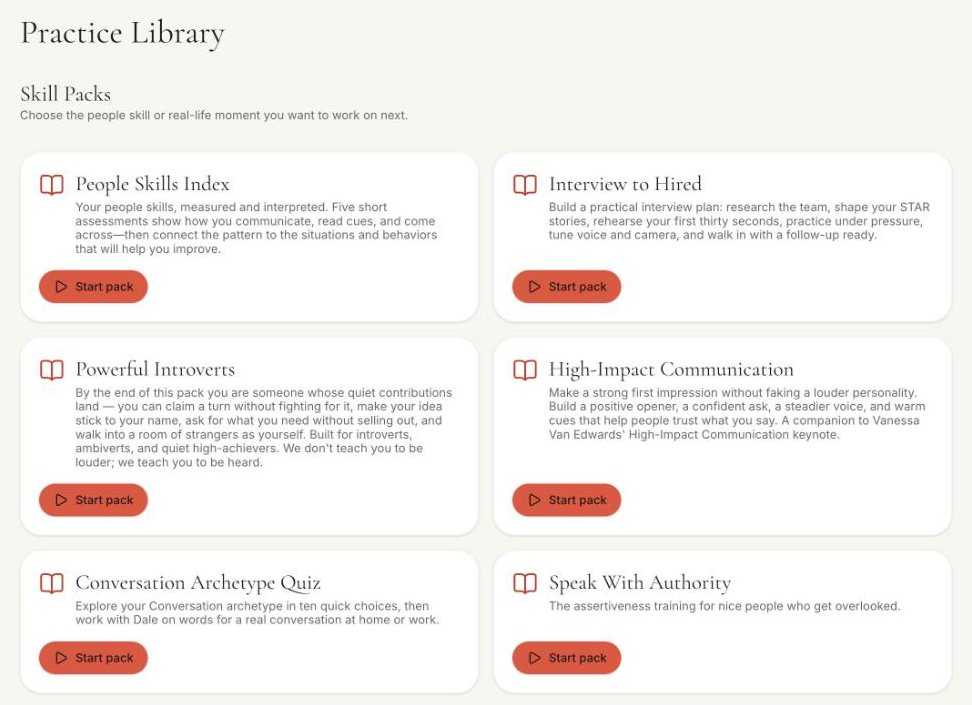
We built ProSocial so you can rehearse the conversation you are actually going to have. The library has 171 voice role-plays, each with a counterpart, a scene, a stated goal, and focus cues. With membership, start from the closest one, and Dale, your personal people-skills coach, sets it up with your situation: who it is with, what you need from them, and what you are worried about. You can rehearse at 10 p.m. the night before, repeat the hardest moment as many times as you need, and never wait for an appointment.
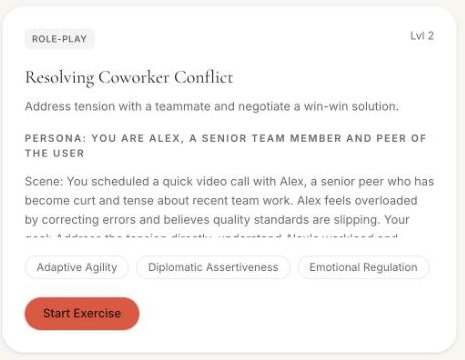
What you practice and how it’s scored. For a peer whose missed deadlines are hurting your project, start from Resolving Coworker Conflict. It is a quick video call with Alex, a senior peer who has become curt and feels overloaded by correcting errors. That is how this conversation usually goes: you raise the deadlines, and the other person answers with their own pressure. Dale sets the role-play up with your peer, the deadlines they missed, and what you need from them, such as a date they will commit to. You practice hearing their side without losing your point, and leaving with an agreement.
- The goal: “Address the tension directly, understand Alex’s workload and quality concerns, and negotiate a workable process without escalating blame.”
- Focus cue: “Open with curiosity about what Alex is experiencing before defending yourself or the team.”
- Focus cue: “Separate the relationship issue from the process issue: tone, workload, review steps, and quality checks.”
- Focus cue: “Look for a specific agreement such as peer review, clearer ownership, or escalation rules.”
- Scored on the People Skills Index skills it’s tagged with, Adaptive Agility, Diplomatic Assertiveness, and Emotional Regulation, then a debrief with Dale.
If the conversation is more about dates than friction, the library also has Negotiating Project Deadlines and Peer-to-Peer Feedback, and Giving Difficult Feedback to a Superior for the same talk with your manager. See the example debrief on this page for what you get back after a run.
ProSocial listens to how you say it, too: whether your voice stays steady under pushback, your pace, and your pauses. Cue Mirror is a live check of your face and hands on your own camera, showing whether you smile, nod, and keep your hands open, so you look calm rather than defensive. With membership, if the conversation is a meeting on your Google or Outlook calendar, Dale helps you prepare and debriefs with you afterward. Email Audit reviews emails you have sent and shows where you hedge or bury your point, which is often where a deadline request first goes soft.
What free and $47 get you. Free, with no card: Dale’s first realistic situation and feedback on it; connecting your calendar and email for feedback, including Email Audit of emails you have sent; and two free programs, the Conversation Archetype Quiz and How to Calm Someone Down, which has two voice role-plays. For one conversation, $47 once buys one program, Difficult People Decoded: its nine video lessons and its three voice role-plays (acknowledge pressure, adapt a request, hold a boundary), with Dale coaching you through that program and setting its role-plays up with your situation. Those three moves are the shape of a missed-deadline talk: acknowledge their workload, adjust what you ask for, and hold firm on what the project needs. You keep it, and nothing renews. Membership is $47 a month or $470 a year (two months free), cancel anytime: full coaching with Dale on your own meetings and messages, which means rehearsing your situations in any of the 171 library role-plays, preparing for meetings on your calendar, and debriefing afterward. It also includes every program and all 171 role-plays, including Resolving Coworker Conflict.
What it will not do: coach you during a live Zoom or Teams call. Those connections are coming soon.
Example debrief · Resolving Coworker Conflict
- Adaptive Agility65/100
- Diplomatic Assertiveness61/100
- Emotional Regulation74/100
Dale“Asking what Alex was dealing with lowered the tension quickly. You then mixed the relationship issue with the process issue, so the agreement stayed vague. Separate them, and leave with one specific change, such as clearer ownership or a review step.”
- What worked
- Opened with curiosity instead of defending yourself.
- Try next
- Agree on one concrete process change before you end.
An example of the debrief format. Your scores and notes come from your own role-play.
2. ChatGPT voice
- Best for
- a do-it-yourself run-through
- Price
- Free with limits; Plus is $20 a month
- Where
- Web, iOS, Android, and desktop
Describe the person, the situation, and how they usually react, then ask it to play them and push back. Gemini and Claude can do the same, and it costs nothing to try.
The catch: you are the coach. You write the scenario, decide how hard it pushes back, and decide what a good answer sounds like. It will not bring its own criteria to the debrief unless you write them.
3. VirtualSpeech
- Best for
- practicing in VR
- Price
- $45 a month or $399 a year
- Where
- Browser, with optional VR
AI role-plays, public-speaking practice, and drills with AI feedback, plus a VR mode that makes practice feel more real. Pick it if you want to practice in VR.
The catch: you pick from its scenarios, and it does not prepare you from your own calendar or email. Monthly, it costs about the same as ProSocial; its $399 annual plan is less than ProSocial’s $470 a year.
4. Yoodli
- Best for
- a low monthly price
- Price
- Free for 5 role-plays in total; Pro is $11 a month, or $8 a month billed annually ($96 a year), up to 10 role-plays a week; Advanced is $28 a month, or $20 a month billed annually, unlimited
- Where
- Web, with Zoom, Microsoft Teams, and Google Meet
Role-plays for conversations like performance reviews and negotiations. If no built-in scenario fits, you can personalize your own conversation, and the free Starter plan covers five role-plays in total. You get a report on your listening, delivery, and speaking patterns afterward. If the real conversation happens on Zoom, Teams, or Google Meet, Yoodli can also give you feedback on the call itself.
The catch: Starter ends after five role-plays in total, and Pro caps you at ten a week, with uploaded recordings counting toward that cap. It does not review the emails you have already sent that peer. ProSocial vs Yoodli
5. Vocal Image
- Best for
- accent training
- Price
- Free daily plan; paid plans from $39.99 a year
- Where
- iOS, Android, and web
AI role-plays for salary negotiations and job interviews, with a character who pushes back and a score afterward, plus accent training across 120+ accents.
The catch: its scenarios lean toward interviews and negotiations, not a conversation with a colleague or a direct report.
6. A trusted colleague, friend, or coach
- Best for
- someone who knows the people involved
- Price
- Free, or a coach’s fee
- Where
- In person or on a call
Someone who knows the other person can tell you how your words will land with them in particular. Ask them to play the other side, and to be less agreeable than they would naturally be.
The catch: they are not available at 10 p.m. the night before, and they will get tired of the tenth run-through before you do.
My pick
If you have a hard conversation with a peer coming up: use ProSocial membership. Start from Resolving Coworker Conflict, tell Dale about the real person, the deadlines, and what you need from them, and rehearse until your opening comes out calmly and you can stay on your point when they answer with their workload.
Yoodli’s free plan lets you personalize a conversation, which is a fair way to try one run. ProSocial gives you two ways to pay. Membership ($47 a month, cancel anytime) includes Resolving Coworker Conflict and the rest of the library: Dale prepares you for this peer, the role-play is scored on Adaptive Agility, Diplomatic Assertiveness, and Emotional Regulation, you get feedback on whether your voice stayed steady when they pushed back, and Dale debriefs with you after the real conversation. Email Audit, free once you connect email, checks the messages where your request may have gone soft. If you would rather not subscribe, Difficult People Decoded is $47 once and you keep it: its lessons and its own three role-plays (acknowledge pressure, adapt a request, hold a boundary), with Dale coaching you through them.
If you want to see how it feels first: sign up free tonight, no card needed. Work through Dale’s first situation, and try the two voice role-plays in How to Calm Someone Down to hear how voice practice and the debrief work.
What I would do today
- Write one sentence that says what you need from the conversation.
- Write down the two reactions you are most worried about, such as “That’s not fair” or a long silence.
- Rehearse out loud and ask the other side to use exactly those reactions.
- Repeat the opening until you can say it calmly without notes.
- If you want a coach for it, join ProSocial membership and tell Dale about the conversation.
Questions
What is the best app to practice difficult conversations?
ProSocial, if you have a specific conversation coming up. With membership, start from the closest of 171 voice role-plays, such as Resolving Coworker Conflict, Dale sets it up with your situation, and the role-play is scored on the skills it builds before you debrief with Dale.
Can I try ProSocial for free?
Yes, and no card is needed. A free account includes Dale’s first realistic situation and feedback on it; connecting your calendar and email for feedback, including Email Audit of emails you have sent; and two free programs, the Conversation Archetype Quiz and How to Calm Someone Down, which has two voice role-plays. For $47 once, you can buy one program, such as Difficult People Decoded: its lessons and its three role-plays, with Dale coaching you through that program and setting its role-plays up with your situation, and you keep it. Membership is $47 a month or $470 a year (two months free), cancel anytime: full coaching with Dale on your own meetings and messages, which means rehearsing your situations in any of the 171 library role-plays, preparing for meetings on your calendar, and debriefing afterward. It also includes every program and all 171 role-plays.
How do I rehearse my own conversation?
With membership, start from the closest of 171 voice role-plays, such as Resolving Coworker Conflict, Negotiating Project Deadlines, Peer-to-Peer Feedback, or Giving Difficult Feedback to a Superior. Dale sets it up with your situation: who it is with, what you need from them, and what you are worried about.
Can I just use ChatGPT to practice?
You can describe the person and ask it to push back, and it will improvise whatever you describe. What you give up is a scenario with a stated goal and focus cues, scoring on the skills it builds, feedback on how steady your voice was, and a coach who prepares you and debriefs with you.
Should I practice with an app or a person?
Both help. An app is available whenever you need it and lets you repeat the hard part as often as you like. A person who knows the people involved can tell you how your words will land with them.
I checked prices and features for every app here in October 2026. They change often, so double-check before you buy.
Head-to-head comparisons
All trademarks belong to their owners and are used here for comparison only.