The best app to practice asking for a raise (2026)
Several apps will play a manager in a salary negotiation. The one worth paying for gets you through the two moments that decide a raise: saying your number as a statement, and holding it when your manager says “not this year.”
TL;DR
For asking for a raise, ask which app will get you ready for your one-to-one, not a generic negotiation. Most raise conversations are lost in two moments: the number comes out sounding like a question, or the first objection turns the case into an apology. With membership, ProSocial rehearses both. “Negotiating a Raise or Promotion” puts your case in front of a supervisor working within budget limits, and High-Impact Communication’s pressured-ask role-play checks whether you stated your number or asked it. Dale, ProSocial’s AI people-skills coach, prepares you for your real one-to-one, and afterward you tell Dale how it went and debrief.
- Best for a raise conversation coming up: ProSocial
- A lower subscription price: Yoodli
- Accent training: Vocal Image
- Someone who knows how your company sets pay: a mentor
The picks at a glance
| App | Best for | Price | Free to start | Rehearses your objections |
|---|---|---|---|---|
| ProSocial | a raise conversation coming up | $47 a month, or $47 once for one program | Yes: Dale’s first situation, calendar and email feedback, two programs | With membership, Dale sets up “Negotiating a Raise or Promotion” with your manager’s likely objections; High-Impact Communication ($47 once) sets its pressured-ask role-play up with your number |
| Yoodli | a lower subscription price | Pro is $11 a month, or $8 a month billed annually, up to 10 role-plays a week; Advanced is $28 a month, or $20 a month billed annually | Yes: 5 role-plays in total | Yes: enter the questions you expect |
| Vocal Image | accent training | Paid plans from $39.99 a year | Daily practice set; the scenario library needs a subscription | An asking-for-a-raise scenario from its library |
| ChatGPT voice | a do-it-yourself run-through | Plus is $20 a month | Yes, with limits | Yes, if you describe them |
| A mentor | someone who knows how your company sets pay | Free, or a coach’s fee | Yes | Yes, if they will play your manager |
Why the number and the first objection change everything
Most people know what they want to ask for. The conversation turns in two places. First, the number: said with an upward lift, or wrapped in “I was kind of hoping for maybe,” it sounds negotiable before anyone has pushed back. Second, the first objection: your manager mentions the budget, says “let’s revisit in six months,” or offers less, and the case you planned turns into an apology.
Both are delivery problems you can rehearse. You say your number out loud until it ends level. You hear the exact objections you are worried about, more than once, until your answer comes out calmly. Then you walk into the one-to-one having already held your number under pressure.
Raise conversations come in three kinds
- The scheduled review. A review or pay cycle is on the calendar. You need your case, one specific number, and the confidence to say it first.
- Asking between reviews. Your role has grown and your pay has not. You need a short, specific account of what changed and what you are requesting.
- Answering “not now” or a lower offer. The first answer is no, later, or less. You need a calm reply that restates your number, asks what it would take, and agrees on when to revisit it.
1. ProSocial Best overall
- Best for
- a raise conversation coming up
- Price
- Free to sign up, no card needed; membership is $47 a month, or $47 once to keep a single program
- Where
- Web, including your phone’s browser (it installs to your home screen like an app)
We built ProSocial so you walk into your one-to-one having already said your number out loud under pressure. With membership, tell Dale, your personal people-skills coach, about your manager, what you delivered this year, your number, and the objections you are dreading. Dale helps you turn that into a short case and a reply to each objection. Then rehearse in the voice role-play “Negotiating a Raise or Promotion” (below), where you make your own case with your own number, and run the hardest moment again until your answer holds.
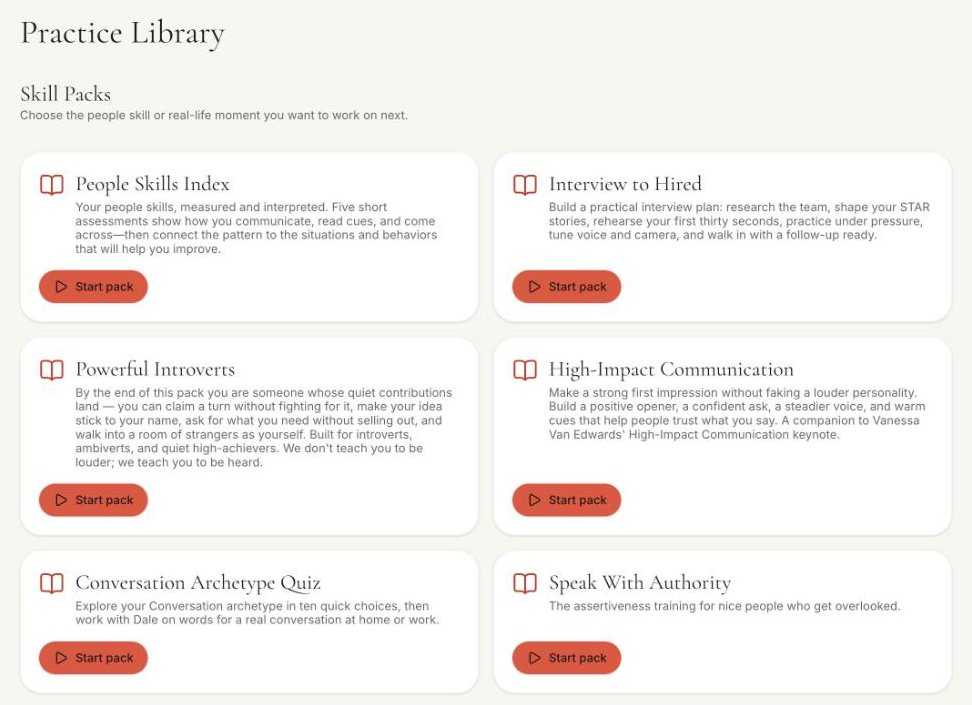
High-Impact Communication covers a positive opener, a confident ask, and a steadier voice, and Speak With Authority, Vanessa Van Edwards’ assertiveness course, covers opening words, voice, and requests. With membership, if the one-to-one is on your Google or Outlook calendar, Dale helps you prepare for it; afterward, you tell Dale how it went, debrief, and get help writing the follow-up message that puts what you agreed in writing.
Because Dale is always available, you can rehearse at 10 p.m. the night before, repeat the objection you dread as many times as you need, and never wait for an appointment.
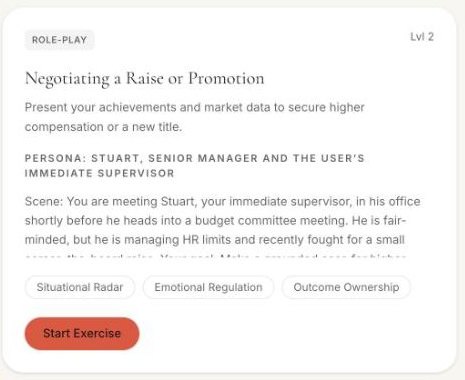
What you practice and how it’s scored. The role-play for the conversation itself is “Negotiating a Raise or Promotion.” You talk to Stuart, your supervisor, just before a budget committee meeting, while he is managing HR limits. The goal: “Make a grounded case for higher compensation or a new title by tying your achievements, scope, and market data to the team’s needs.” The focus cues:
- “Lead with evidence: results, expanded responsibilities, and market or internal comparison points.”
- “Acknowledge budget constraints without abandoning your ask or becoming apologetic.”
- “Try to secure a concrete next step if Stuart cannot approve the raise today.”
It is scored on the People Skills Index skills it’s tagged with, Situational Radar, Emotional Regulation, and Outcome Ownership, then you debrief with Dale (see the example debrief below). Start from “Negotiating a Raise or Promotion,” and Dale sets it up with your situation: your manager, your number, and the objections you expect.
The delivery check on your number comes from a second role-play: the pressured ask in High-Impact Communication. Its debrief is scored on the transcript and audio:
- “Opened warm, not sterile or negative.”
- “Stated the number, didn’t ask it”: it ends level, with no upward lift or hedge.
- “Held the number under pushback, and met heat with warmth”: your voice stayed steady, with no over-explaining or folding.
- “Warmth as a listener, in the voice”: at least one audible listening move.
What each option includes.
- Free, with no card: Dale’s first realistic situation, which may not be your raise, and feedback on it; connecting your calendar and email for feedback, including Email Audit of emails you have sent; and two free programs, the Conversation Archetype Quiz and How to Calm Someone Down, which has two voice role-plays.
- $47 once, and you keep it: High-Impact Communication, which includes the pressured-ask role-play scored on “stated the number, didn’t ask it,” a warm-opener role-play, the Charisma Quiz, Charisma Coach, Cue Mirror, and its lessons, with Dale coaching you through that program and setting its role-plays up with your situation.
- $47 a month or $470 a year (two months free), cancel anytime: membership. Full coaching with Dale on your own meetings and messages, such as your case and your follow-up message, which means rehearsing your situations in any of the 171 library role-plays, preparing for meetings on your calendar, and debriefing afterward. It also includes every program and all 171 role-plays, including both role-plays above.
What it will not do: give you salary data for your role. Bring a number from your own research. It also will not coach you during a live Zoom or Teams call; those connections are coming soon.
Example debrief · Negotiating a Raise or Promotion
- Situational Radar68/100
- Emotional Regulation74/100
- Outcome Ownership61/100
Dale“Your results were strong and specific. When Stuart mentioned the budget, you apologized and softened the number. Acknowledge the constraint once, restate the number, and ask what would make it possible next quarter.”
- What worked
- Led with results and expanded scope instead of tenure.
- Try next
- Hold the number after the budget objection, and leave with a dated next step.
An example of the debrief format. Your scores and notes come from your own role-play.
2. Yoodli
- Best for
- a lower subscription price
- Price
- Starter is free for 5 role-plays in total; Pro is $11 a month, or $8 a month billed annually, up to 10 role-plays a week; Advanced is $28 a month, or $20 a month billed annually, unlimited
- Where
- Web
Role-plays for negotiations and performance reviews. You can personalize the conversation or enter the questions you think your manager will ask, then get a report on your delivery, filler words, and weak words.
The catch: it does not advertise preparing you for the meeting on your calendar. ProSocial vs Yoodli
3. Vocal Image
- Best for
- accent training
- Price
- Free daily plan; paid plans from $39.99 a year
- Where
- iOS, Android, and web
An AI voice and communication coach whose role-play library includes asking for a raise. The AI plays your manager, resists, and changes course depending on what you say, and the feedback afterward points to specific moments in the exchange. It also offers accent training.
The catch: the free plan covers the daily practice set only, so the raise scenario needs a subscription. It does not advertise preparing you from your calendar or debriefing after the real conversation. ProSocial vs Vocal Image
4. ChatGPT voice
- Best for
- a do-it-yourself run-through
- Price
- Free with limits; Plus is $20 a month
- Where
- Web, iOS, Android, and desktop
Describe your manager, your case, and your number, then ask it to play your manager and push back. Gemini and Claude can do the same.
The catch: you are the coach. It will not score whether your number ended level, tell you what to work on, or ask how the conversation went. ProSocial vs ChatGPT
5. A mentor or trusted colleague
- Best for
- someone who knows how your company sets pay
- Price
- Free, or a coach’s fee
- Where
- In person or on a call
Someone who has managed people at your company can tell you when pay decisions get made, who makes them, and whether your number is realistic there. Ask them to play your manager, and to be tougher than they would naturally be.
The catch: they are not available at 10 p.m. the night before, and they will tire of the tenth run-through before you do.
My pick
If you have a raise conversation in the next few weeks: use ProSocial for a month. Build your case with Dale, rehearse your number until it ends level, practice your answer to “not this year” and to a lower offer, and tell Dale afterward how it went. One month of membership covers the weeks before the conversation, and gives you both “Negotiating a Raise or Promotion” and the pressured-ask role-play.
If you would rather not subscribe: pay $47 once for High-Impact Communication and keep it. It includes the pressured-ask role-play scored on stating your number and holding it under pushback, a warm-opener role-play, and Dale coaching you through the program and setting its role-plays up with your situation. “Negotiating a Raise or Promotion” and coaching on your case beyond the program come with membership. If you want to try it first, sign up free tonight.
What I would do today
- Pick one specific number, not a range, from what similar roles pay and what you delivered. A range invites the bottom of it.
- List three things you delivered this year that your manager would agree with.
- Write the number and your reason as one sentence, and say it out loud until it ends as a statement, not a question.
- Write the two objections you are most worried about, such as “The budget is set” or “Let’s revisit in six months.”
- Decide your reply to a lower offer: thank them, restate your number and reason once, and ask what it would take to get there. You can ask for a day to think rather than accepting on the spot.
- Decide your reply to “not now”: ask what would need to be true, and agree on a specific date to revisit it.
- With membership, tell Dale those objections, then rehearse out loud in ProSocial’s “Negotiating a Raise or Promotion” role-play.
Questions
What is the best app to practice asking for a raise?
ProSocial, if you have a raise conversation coming up. With membership, Dale helps you build your case and your replies to your manager’s likely objections, you rehearse it in the “Negotiating a Raise or Promotion” voice role-play, and the pressured-ask role-play in High-Impact Communication checks whether you stated the number and held it under pushback. Afterward, you tell Dale how the real conversation went and debrief.
Can I try ProSocial for free?
Yes, and no card is needed. A free account includes Dale’s first realistic situation, which may not be your raise, and feedback on it; connecting your calendar and email for feedback, including Email Audit of emails you have sent; and two free programs, the Conversation Archetype Quiz and How to Calm Someone Down, which has two voice role-plays. For $47 once, you can buy one program, such as High-Impact Communication with the pressured-ask role-play: its lessons and its role-plays, with Dale coaching you through that program and setting those role-plays up with your situation, and you keep it. Membership is $47 a month or $470 a year (two months free), cancel anytime: full coaching with Dale on your own meetings and messages, which means rehearsing your situations in any of the 171 library role-plays, preparing for meetings on your calendar, and debriefing afterward. It also includes every program and all 171 role-plays, including “Negotiating a Raise or Promotion.”
How do I respond if my manager offers less than I asked for?
Thank them, restate your number and your reason once without over-explaining, and ask what it would take to get there. You do not have to accept on the spot; asking for a day to think is reasonable.
How do I respond if my manager says “not this year”?
Stay calm, ask what would need to be true to get there, and agree on a specific date to revisit it. Rehearsing that reply in advance keeps a “no” from ending the conversation.
Will ProSocial tell me what number to ask for?
No. ProSocial does not provide salary data, so bring a number from your own research. With membership, Dale helps you build the case for it, and the role-play helps you say it and hold it.
I checked prices and features for every app here in October 2026. They change often, so double-check before you buy.
Head-to-head comparisons
All trademarks belong to their owners and are used here for comparison only.