The best app to improve your social skills as an adult (2026)
You already know the advice: make eye contact, ask questions, listen more. The question is which app shows you what to work on first and gives you enough real practice, at work and outside it, that the advice starts to show up when it counts.
TL;DR
Ask two things of any option: will it help you find the skill that is actually holding you back, and will it give you practice in the situations you find hard, from small talk with a stranger to a tense moment with someone upset? Most people practice what already feels comfortable. ProSocial starts with an assessment that shows which of seven skills to work on first, then gives you voice role-plays, face-reading drills, and Dale, an AI people-skills coach you can practice with at 10 p.m. before the party or the hard conversation, as many times as you need.
- Best overall for knowing what to work on and practicing it: ProSocial
- A lower monthly price: Gleam
- Accent training: Vocal Image
- A live audience: Toastmasters
The picks at a glance
| Option | Best for | Price | How you practice |
|---|---|---|---|
| ProSocial | knowing what to work on, then practicing it | Free to sign up, no card needed; $47 a month, or $47 once for one program | A skills assessment, voice role-plays for social life and work, face-reading drills, and a coach |
| Gleam | a lower monthly price | Free with a daily lesson limit; $12.99 a month, or yearly plans from $39.99 | Scenario lessons, quizzes, and practice conversations on iOS and Android |
| Vocal Image | accent training | Free daily plan; paid plans from $39.99 a year | Voice exercises and AI role-plays, including first dates |
| ChatGPT voice | a do-it-yourself run-through | Free with limits; Plus is $20 a month | Open-ended voice conversations you set up yourself |
| Toastmasters | a live audience | $72 every six months, plus a $25 new-member fee | Prepared speeches at club meetings |
| A therapist | when anxiety, not skill, is what holds you back | Varies | Sessions with a licensed professional |
Why knowing what to work on first changes everything
Most adults who want to get better with people have read the articles. The trouble is that you tend to practice the parts that feel comfortable, and the skill that actually holds you back is often the one you cannot see in yourself. Someone who rates their own warmth highly may come across as guarded. Someone who thinks they read people well may miss the cue that the other person wants to leave.
When you know whether your gap is reading people, staying steady when a conversation gets tense, or getting your point across warmly, you stop practicing everything and start practicing the one thing that changes how people respond to you. Then you need enough practice in the situations where it matters, at work and outside it.
Social skills come in three kinds
- Reading the situation. Noticing what someone feels before they say it, and picking up the cues in a conversation. Practice with real faces helps most here.
- Managing yourself. Staying steady when someone pushes back, owning what happens next, and adjusting when the conversation changes. You need practice under some pressure.
- Coming across the way you mean to. Making your point clear, showing warmth, and saying what you need without damaging the relationship. It helps to hear how you sound and see how you look.
1. ProSocial Best overall
- Best for
- knowing what to work on, then practicing it
- Price
- Free to sign up, no card needed; membership is $47 a month, or $47 once for one program
- Where
- Web (installs to your phone’s home screen like an app), Telegram, a Chrome extension for Gmail, and Dale for Mac
We built ProSocial to start from where you actually are. The People Skills Index is a roughly 30-minute assessment: you respond to short video situations, speak, write, read facial cues, and rate yourself. Your results cover seven skills (Situational Radar, Emotional Regulation, Outcome Ownership, Adaptive Agility, Strategic Clarity, Relational Warmth, and Diplomatic Assertiveness) and show which to work on first, including gaps between how you rate yourself and how you respond. Dale, your personal people-skills coach, turns that into a practice focus.
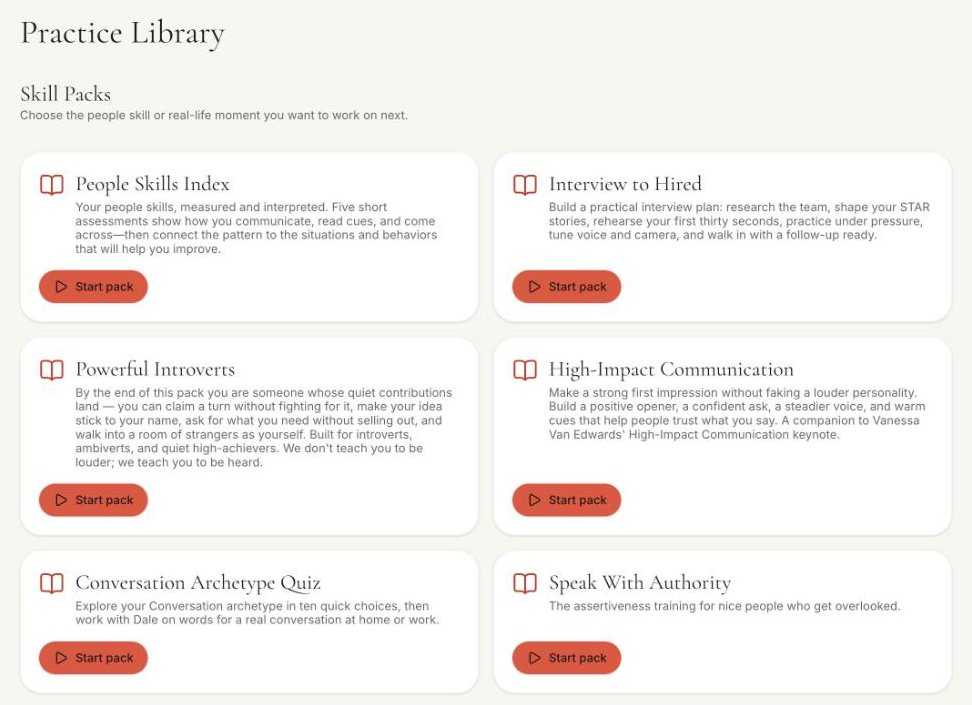
Then you practice, at work and outside it. Role-plays come from the ProSocial library, which holds 171 voice role-plays. With membership, start from the closest one, such as Asking Someone Out, and Dale sets it up with your situation: who it is with, what you want from it, and what worries you. Library role-plays for life outside work include:
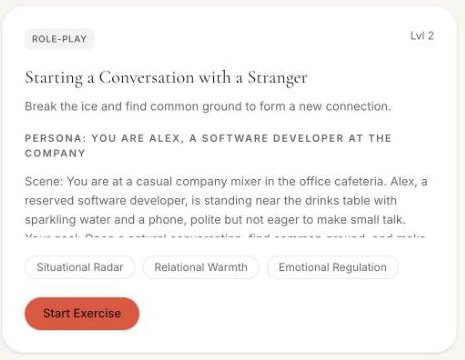
- Starting a Conversation with a Stranger
- Reconnecting with a Friend After a Long Time
- Asking Someone Out
- Define the Relationship Talk
- Calm someone down: listen first
What you practice and how it’s scored. The example here is set at work, and the skill is the one you need at a party. In Starting a Conversation with a Stranger, you are at a casual company mixer. Alex, a reserved software developer, is polite but not eager to make small talk. The goal: “Open a natural conversation, find common ground, and make the interaction feel welcome rather than forced.” It is tagged Situational Radar, Relational Warmth, and Emotional Regulation, and it is scored on those three skills, then you debrief with Dale (see the example debrief below). For life outside work, start from Reconnecting with a Friend After a Long Time, Asking Someone Out, or Define the Relationship Talk. Each is scored the same way, on the People Skills Index skills it’s tagged with.
For reading people, Microexpression Training teaches you to read the faces of the people you talk to, and Cue Mirror shows your own smile, nods, and hand gestures in a live check that runs on your device. Both come with membership; Cue Mirror is also in High-Impact Communication, and Microexpression Training in Interview to Hired, each $47 once. Powerful Introverts covers claiming a turn, asking for what you need, and walking into a gathering of strangers as yourself, and includes the Networking Icebreaker role-play. Role-plays also cover work: meetings, interviews, and difficult people.
ProSocial works in your phone’s browser and installs to your home screen like an app. If you also want a person, you can work with a People Coach certified through Science of People’s People Coach program through a separate relationship, arranged and priced with the coach.
What free and $47 get you. A free account, with no card, includes Dale’s first realistic situation and feedback on it; connecting your calendar and email for feedback, including Email Audit of emails you have sent; and two free programs, the Conversation Archetype Quiz and How to Calm Someone Down, which has two voice role-plays. Membership is $47 a month or $470 a year (two months free), cancel anytime: full coaching with Dale on your own meetings and messages, which means rehearsing your situations in any of the 171 library role-plays, preparing for meetings on your calendar, and debriefing afterward. It also includes every program, including the People Skills Index, and all 171 role-plays. If you would rather pay once, $47 buys one program, such as the People Skills Index on its own: its five assessment modules, your results, and Dale coaching you through them, and you keep it. It has no role-plays; for those, buy a program such as Powerful Introverts or join membership. Role-plays beyond the free programs come with membership or inside other $47 programs, such as Powerful Introverts.
What it will not do: coach you during a live Zoom or Teams call. Those connections are coming soon.
Example debrief · Starting a Conversation with a Stranger
- Situational Radar70/100
- Relational Warmth66/100
- Emotional Regulation77/100
Dale“Asking about the drinks table was easy for Alex to answer. When Alex gave short replies, you filled the silence with your own stories. Ask one curious follow-up about what Alex mentioned, and let a pause happen.”
- What worked
- Used the setting for a low-pressure opener.
- Try next
- Follow Alex’s answer with one curious question instead of a story of your own.
An example of the debrief format. Your scores and notes come from your own role-play.
2. Gleam
- Best for
- a lower monthly price
- Price
- Free with a daily lesson limit; $12.99 a month, or yearly plans from $39.99
- Where
- iOS and Android
A phone app with scenario-based lessons, quizzes, and practice conversations, with AI feedback and progress tracking. Its topics include dating, networking, active listening, and emotional intelligence. It costs $12.99 a month, or from $39.99 a year.
The catch: its App Store listing does not describe an assessment that compares how you rate yourself with how you respond, or drills for reading facial expressions.
3. Vocal Image
- Best for
- accent training
- Price
- Free daily plan; paid plans from $39.99 a year
- Where
- iOS, Android, and web
Started as voice training and added AI role-plays for interviews, salary talks, and first dates. It detects 120+ accents. Pick it if your accent is the thing you want to work on.
The catch: its tests and lessons center on how you sound, not on reading other people. ProSocial vs Vocal Image
4. ChatGPT voice
- Best for
- a do-it-yourself run-through
- Price
- Free with limits; Plus is $20 a month
- Where
- Web, iOS, Android, and desktop
Ask it to play someone at a party or a new coworker and practice keeping the conversation going. Gemini and Claude can do the same.
The catch: you are the coach. You decide what to practice and judge how it went. It will not show you which skill to work on, score how you sounded against set criteria, or keep track of your progress.
5. Toastmasters
- Best for
- a live audience
- Price
- $72 every six months, plus a $25 new-member fee
- Where
- In-person and online clubs
No app recreates a group of real people listening to you. Pick it if you want regular practice speaking in front of others.
The catch: it is built for speeches, not one-on-one conversations, and it runs on the club’s schedule.
6. A therapist
- Best for
- when anxiety, not skill, is what holds you back
- Price
- Varies
- Where
- In person or online
If fear of social situations stops you from going at all, or if something beyond skills is getting in the way, talk to a licensed professional. An app is practice, not treatment.
The catch: sessions are usually weekly, and most of the practice still happens between them.
My pick
If you want to get better with people and do not know where to start: use ProSocial. Take the People Skills Index, let Dale build a practice focus from your results, and rehearse the situations you find hard, at work and outside it.
On price: Gleam costs less, at $12.99 a month against ProSocial’s $47, or from $39.99 a year against $470 a year for ProSocial membership. The $47 a month buys the assessment, every program, the full library of voice role-plays and drills, including the ones for dating, friendships, and meeting strangers, and a coach who prepares you and follows up, and you can cancel anytime. If a monthly plan is more than you want to commit, $47 once buys the People Skills Index on its own, with its five assessment modules and Dale coaching you through your results. Start free tonight, with no card: work through Dale’s first realistic situation, take the Conversation Archetype Quiz, and try the How to Calm Someone Down role-plays before you decide.
What I would do today
- Think of one recent conversation, at work or outside it, that did not go the way you wanted.
- Write down what you think went wrong, and what the other person might say went wrong.
- Pick one moment in it you would handle differently.
- Say what you would say instead, out loud, until it feels natural.
- If you want to know what to work on first and a coach to practice with, join ProSocial membership, take the People Skills Index, and rehearse the moment in the closest library role-play.
Questions
What is the best app to improve social skills?
ProSocial, if you want to know what to work on first and then practice it. The People Skills Index shows which of seven skills to start with, and Dale coaches you with voice role-plays, face-reading drills, and programs for situations at work and outside it.
What is the People Skills Index?
A roughly 30-minute assessment. You respond to short video situations, speak, write, read facial cues, and rate yourself. Your results cover seven skills and show which ones to work on first, including gaps between how you rate yourself and how you respond. It is included in membership. You can also buy it on its own for $47 once: you get its five assessment modules, your results, and Dale coaching you through them, and you keep it. Role-plays beyond the free programs come with membership or inside other $47 programs, such as Powerful Introverts.
Does ProSocial help outside work?
Yes. Library role-plays for life outside work include Reconnecting with a Friend After a Long Time, Asking Someone Out, Define the Relationship Talk, and Calm someone down: listen first. Starting a Conversation with a Stranger is set at a company mixer, and it practices the same opening move you use at a party. Microexpression Training helps you read other people’s faces, Cue Mirror shows your own expressions and gestures on camera, and with Dale for Mac you can talk through a selected Apple Messages conversation and draft a reply you send yourself.
Can I try ProSocial for free?
Yes, and no card is needed. A free account includes Dale’s first realistic situation and feedback on it; connecting your calendar and email for feedback, including Email Audit of emails you have sent; and two free programs, the Conversation Archetype Quiz and How to Calm Someone Down, which has two voice role-plays. For $47 once, you can buy one program, such as the People Skills Index: its five assessment modules and your results, with Dale coaching you through them, and you keep it. It has no role-plays; for those, buy a program such as Powerful Introverts or join membership. Membership is $47 a month or $470 a year (two months free), cancel anytime: full coaching with Dale on your own meetings and messages, which means rehearsing your situations in any of the 171 library role-plays, preparing for meetings on your calendar, and debriefing afterward. It also includes every program, including the People Skills Index, and all 171 role-plays.
Can adults really improve their social skills?
Yes. Social skills are trainable, like any skill. Personality is fairly stable, but how you read people, manage yourself, and come across can all be practiced.
Is ProSocial therapy?
No. ProSocial is coaching and practice for people skills. If anxiety or another health concern is getting in the way, talk to a licensed professional.
I checked prices and features for every app here in October 2026. They change often, so double-check before you buy.
Head-to-head comparisons
All trademarks belong to their owners and are used here for comparison only.