The best app to improve small talk and networking (2026)
Most people who freeze with strangers already know a few openers. The freeze comes on the second line, when the other person says something you did not expect. The practice worth paying for rehearses that second line out loud, before the event.
TL;DR
For small talk and networking, ask whether the practice answers back. Memorized openers fall apart when the other person gives a one-word answer, asks what you do, or changes the subject. Rehearsing with a counterpart who responds to what you actually say, then getting a debrief on how you came across, is what makes the second line easier. ProSocial does that with a networking role-play, and with membership, Dale, its AI people-skills coach, prepares you for the specific event you have coming up, then helps with the follow-up.
- Best for an event or introduction coming up: ProSocial
- Practicing with real strangers: Meetup
- Thinking on your feet in front of real people: Toastmasters
- Accent training: Vocal Image
The picks at a glance
| Option | Best for | Price | Free to start | Who you practice with |
|---|---|---|---|---|
| ProSocial | an event or introduction coming up | $47 a month, or $47 once for a program that includes “Networking Icebreaker” | Yes: Dale’s first situation, calendar and email feedback, two programs | A voice counterpart, such as a stranger at a networking event, who responds to what you say; then a scored debrief |
| Meetup | practicing with real strangers | Free to join; some groups charge dues | Yes | Real people, with no feedback |
| Toastmasters | thinking on your feet in front of real people | $72 every six months, plus a $25 new-member fee | Yes: visiting a club is free | A live audience |
| Vocal Image | accent training | Paid plans from $39.99 a year | Yes: a daily practice set | AI characters from its scenario library |
| ChatGPT voice | a do-it-yourself run-through | Plus is $20 a month | Yes, with limits | Whoever you describe; you are the coach |
Why practicing the second line changes everything
The opener is the easy part. The trouble starts on the second line. The other person gives a one-word answer, asks what you do, or mentions something you know nothing about, and the script you prepared is no help. That is the moment people freeze.
You cannot rehearse that moment by reading a list of lines. You rehearse it by saying something out loud, hearing a response you did not write, and answering it, again and again, until reaching for the next question feels familiar. Then you go to the event with a clear answer to “So what do you do?”, a few questions that go past small talk, and a plan for the follow-up, which is where most networking quietly ends.
Small talk and networking come in three kinds
- Meeting someone new. A conference, a mixer, a friend’s party. You need an easy opener and a clear answer to “So what do you do?”
- Keeping a conversation going. The second line, the conference lunch table, a coworker you only half know. You need follow-up questions, something of your own to share, and to sound interested while you listen.
- Following up afterward. The message that turns a good conversation into a coffee or an introduction. Writing it well matters as much as the conversation did.
1. ProSocial Best overall
- Best for
- an event or introduction coming up
- Price
- Free to sign up, no card needed; membership is $47 a month, or $47 once to keep a single program
- Where
- Web, including your phone’s browser (it installs to your home screen like an app), plus a Chrome extension for Gmail
We built ProSocial so you practice the moment, not a list of lines. With membership, tell Dale, your personal people-skills coach, about the conference and who you hope to meet, or connect Google or Outlook and Dale helps you prepare for what is on your calendar. Dale helps you build a short, clear answer to “So what do you do?” and a few questions worth asking.
Then rehearse out loud in the voice role-play “Networking Icebreaker” (below). The person you approach answers what you actually said, not a line you scripted, so you practice the second line, not just the first. If your freeze is the person who gives short answers, membership adds “Starting a Conversation with a Stranger,” where the other person is polite but not eager to make small talk, scored on Situational Radar, Relational Warmth, and Emotional Regulation. Voice analysis checks your pace, pauses, energy, filler words, and whether your voice stays steady when you are nervous.
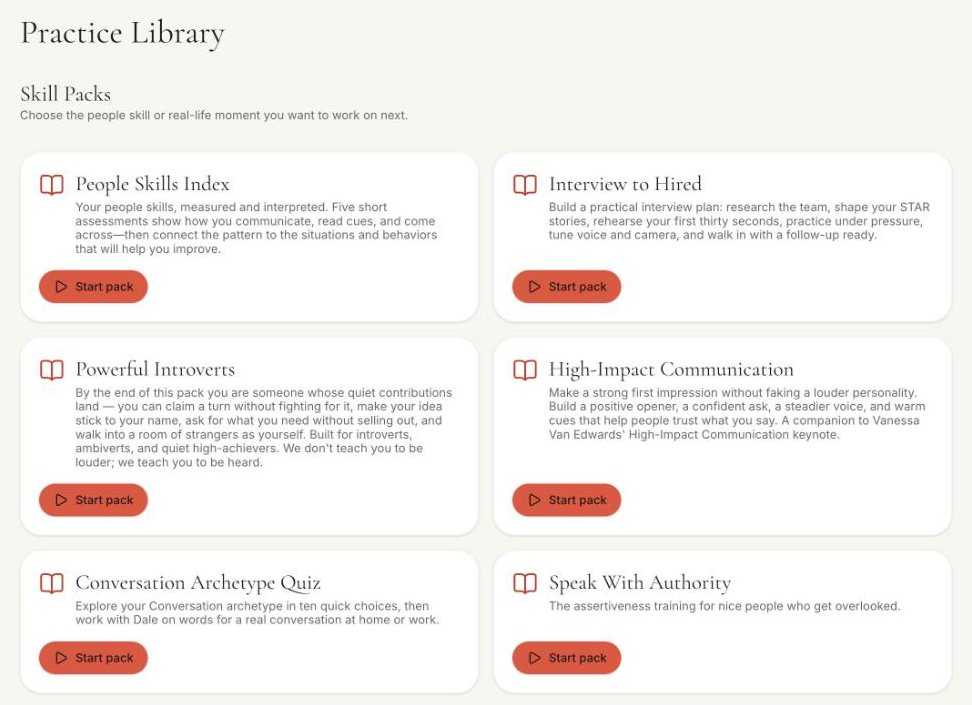
The program built for this is Powerful Introverts, which covers walking into a room of strangers as yourself. It includes “Networking Icebreaker,” the Logline Workshop for a short, clear answer to “So what do you do?”, and the Follow-up Writer for the message afterward. High-Impact Communication covers warmth and competence, a positive opener, and warm cues, with a warm-opener role-play and Cue Mirror, a live, on-device camera check of your face and hands, so you can see what they are doing before you walk in. After the event, the Charisma Coach Chrome extension, which comes with High-Impact Communication or membership, scores your Gmail follow-up draft for warmth and competence.
Because Dale is always available, you can rehearse at 10 p.m. the night before, or on your phone in the hotel before the first session, as many times as you need.
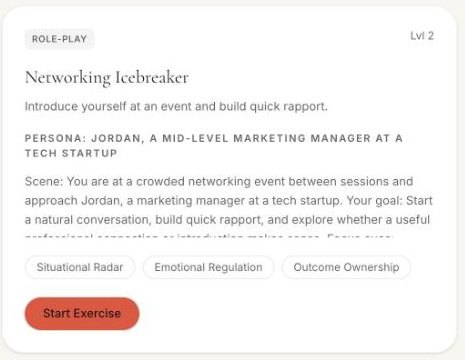
What you practice and how it’s scored. In “Networking Icebreaker,” you are at a crowded networking event between sessions, and you approach Jordan, a marketing manager at a tech startup. The goal: “Start a natural conversation, build quick rapport, and explore whether a useful professional connection or introduction makes sense.” The focus cues:
- “Open with context from the event instead of launching into a pitch.”
- “Ask about Jordan’s work and listen for shared interests or complementary networks.”
- “Earn the right to ask for a follow-up or introduction by offering relevance first.”
It is scored on the People Skills Index skills it’s tagged with, Situational Radar, Emotional Regulation, and Outcome Ownership, then you debrief with Dale (see the example debrief below). Start from “Networking Icebreaker,” and Dale sets it up with your situation: who will be there, who you hope to meet, and what you are worried will happen.
What each option includes.
- Free, with no card: Dale’s first realistic situation and feedback on it; connecting your calendar and email for feedback, including Email Audit of emails you have sent; and two free programs, the Conversation Archetype Quiz and How to Calm Someone Down, which has two voice role-plays.
- $47 once, and you keep it: Powerful Introverts, which includes “Networking Icebreaker,” “Speaking Up in a Meeting,” “Addressing a Colleague Taking Credit for Your Work,” the Logline Workshop and Follow-up Writer tools, and its lessons, with Dale coaching you through that program and setting its role-plays up with your situation.
- $47 a month or $470 a year (two months free), cancel anytime: membership. Full coaching with Dale on your own meetings and messages, which means rehearsing your situations in any of the 171 library role-plays, preparing for meetings on your calendar, and debriefing afterward. It also includes every program and all 171 role-plays, including “Starting a Conversation with a Stranger.”
What it will not do: coach you live at the event itself, or during a Zoom or Teams call. Those call connections are coming soon.
Example debrief · Networking Icebreaker
- Situational Radar73/100
- Emotional Regulation70/100
- Outcome Ownership58/100
Dale“Opening with the session you had both just left made it easy for Jordan to answer. You asked good questions, then ended without suggesting a follow-up. Offer one useful connection or idea, then ask whether to stay in touch.”
- What worked
- Used the event as the opener instead of a pitch.
- Try next
- Offer something relevant before asking for the follow-up.
An example of the debrief format. Your scores and notes come from your own role-play.
2. Meetup
- Best for
- practicing with real strangers
- Price
- Free to join; some groups charge their own dues
- Where
- Local groups and events
Not an app for practice, but a place to do it. Find a group built around something you enjoy, go regularly, and every event is a fresh set of introductions with people who came to meet someone. Pick it for low-stakes exposure to real strangers before a bigger event.
The catch: there is no rehearsal and no feedback. If a conversation stalls, nobody tells you why, and you will not know what to change for next time.
3. Toastmasters
- Best for
- thinking on your feet in front of real people
- Price
- $72 every six months, plus a one-time $25 new-member fee; visiting a club is free
- Where
- In-person and online clubs
Table Topics, a regular part of club meetings, asks you to answer a question you have not seen, for one to two minutes. It is a regular workout for speaking without a script, in front of real people.
The catch: it is a short talk to a group, not a back-and-forth with one person, and it runs on the club’s schedule rather than before your event.
4. Vocal Image
- Best for
- accent training
- Price
- Free daily plan; paid plans from $39.99 a year
- Where
- iOS, Android, and web
An AI voice and communication coach with role-plays that include opening a conversation with a stranger and keeping small talk alive. You say your lines out loud and the AI answers in character. It also offers accent training.
The catch: the full scenario library needs a subscription, and it does not advertise helping you prepare for a specific event or write the follow-up. ProSocial vs Vocal Image
5. ChatGPT voice
- Best for
- a do-it-yourself run-through
- Price
- Free with limits; Plus is $20 a month
- Where
- Web, iOS, Android, and desktop
Describe the event and the kind of person you expect to meet, then ask it to play them. Gemini and Claude can do the same.
The catch: you are the coach. It will not score the conversation on specific skills, keep track of your progress, or ask how the event went. ProSocial vs ChatGPT
My pick
If you have a conference, a dinner, or an introduction coming up: use ProSocial membership. Prepare for it with Dale, rehearse the first few minutes and the second line out loud, and write the follow-up the next morning.
If you have a few weeks: join ProSocial membership, rehearse “Networking Icebreaker” until the second line feels familiar, then try it at a Meetup group before the big event. If you would rather not subscribe, pay $47 once for Powerful Introverts and keep it: it includes “Networking Icebreaker” and the Follow-up Writer. If you want to try ProSocial first, sign up free.
What I would do today
- Pick the next event where you will meet someone new.
- Write a one-sentence answer to “So what do you do?” that a stranger would understand.
- Write three questions you could ask that go one step past “Where are you from?”
- Plan your reply to a one-word answer: share something small about yourself, then ask again.
- Say all of it out loud until it sounds like you talking, not reading.
- Decide now who you will follow up with, and when.
- If you want a coach for it, join ProSocial membership and tell Dale about the event.
Questions
What is the best app to improve small talk?
ProSocial, if you have a real event or introduction coming up. You rehearse in the “Networking Icebreaker” voice role-play, where the person you approach responds to what you say, get a scored debrief, and, with membership, prepare for the event with Dale and get help with the follow-up afterward.
Can I try ProSocial for free?
Yes, and no card is needed. A free account includes Dale’s first realistic situation and feedback on it; connecting your calendar and email for feedback, including Email Audit of emails you have sent; and two free programs, the Conversation Archetype Quiz and How to Calm Someone Down, which has two voice role-plays. For $47 once, you can buy one program, such as Powerful Introverts with “Networking Icebreaker”: its lessons and its role-plays, with Dale coaching you through that program and setting those role-plays up with your situation, and you keep it. Membership is $47 a month or $470 a year (two months free), cancel anytime: full coaching with Dale on your own meetings and messages, which means rehearsing your situations in any of the 171 library role-plays, preparing for meetings on your calendar, and debriefing afterward. It also includes every program and all 171 role-plays.
How realistic is a small-talk role-play?
In ProSocial’s “Networking Icebreaker,” you speak out loud to Jordan, a marketing manager at a tech startup, and Jordan responds to what you actually said, so you cannot rely on a script. In “Starting a Conversation with a Stranger,” the other person is polite but not eager to make small talk. Each role-play is scored on the People Skills Index skills it’s tagged with, then you debrief with Dale.
What is the best way to practice networking if I am nervous?
Rehearse privately first, then go somewhere low-stakes. Practice the first few minutes of a conversation out loud, then try it at a group event where people came to meet someone new, before the event that matters.
Can I just use ChatGPT to practice small talk?
For a quick warm-up, yes. Describe the event and ask it to play the other person. What you give up is a scored debrief on how you came across, programs built for meeting strangers, and a coach who helps with the follow-up.
I checked prices and features for every app here in October 2026. They change often, so double-check before you buy.
Head-to-head comparisons
All trademarks belong to their owners and are used here for comparison only.